
b2b space CRO: Every Click Must Be Monetised – Maximising Visitor Value
Note: We’re currently focused on a long-term project and are not accepting new client orders. For partnership or careers (Developers, SEO, PPC), please reach out via /contact.
Why CRO matters in complex B2B
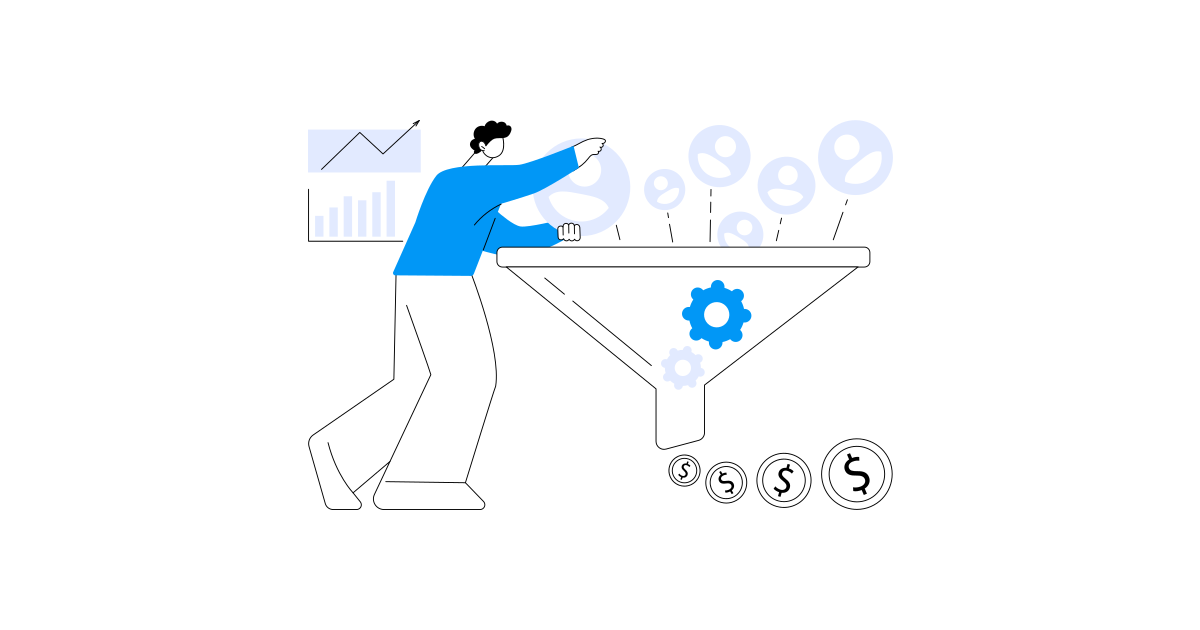
Conversion Rate Optimisation (CRO) improves ROI by extracting more value from existing traffic—without relying solely on increasing advertising budgets. In construction, manufacturing, and services, where decision-making can be slow and acquisition costs can be high, CRO helps teams:
- Increase value per visit: Improve the share of visitors who complete meaningful steps (e.g., inquiries, spec downloads, demo requests).
- Reduce cost per qualified inquiry: Better conversion efficiency tends to lower CPL/CPA for the same media spend.
- Reduce friction and ambiguity: Clearer UX, stronger trust signals, and fewer blockers reduce drop-offs.
- Make decisions measurable: Instrumentation and experiments help validate what is actually improving outcomes.
A CRO process: from research to iteration
A CRO process aims to make the path to action clearer, faster, and easier to measure. A typical CRO cycle includes:
- Baseline and instrumentation: Define what “success” means and ensure key steps are tracked end-to-end.
- Behaviour analysis: Use analytics, funnels, and qualitative signals to find drop-offs and friction points.
- Hypotheses and prioritisation: Translate findings into testable changes and prioritise by impact and effort.
- Controlled changes: Run A/B tests or staged rollouts to isolate what moved the metric.
- Review and iteration: Document learnings, ship what works, and repeat with the next highest-leverage bottleneck.
Common CRO mistakes
- Testing without a clear question, baseline, or decision rule.
- Changing ten things at once (and then not knowing what mattered).
- Missing tracking and definitions for “qualified,” which makes outcomes impossible to judge.
- Ignoring mobile UX and performance.
- Treating CRO as a one-off redesign instead of a continuous loop.
Minimum analytics stack
- Web analytics (GA4 or an equivalent) with consistent naming.
- Event tracking for key steps (forms, calls, downloads, key interactions).
- Conversion definitions that map to qualification (not just “a submit happened”).
- Heatmaps and/or session replay for qualitative diagnostics.
- A way to run controlled experiments (A/B tests or staged rollouts).
- CRM/back-end feedback to judge lead quality where possible.
Mini example (before / after)
Before: A long, multi-field form sits behind a vague CTA. Users reach the form but abandon it, and it’s unclear which sources produce qualified inquiries.
After: Friction is reduced (clearer CTA, fewer fields, better error states), and tracking connects submissions to qualification. The form becomes easier to complete and easier to evaluate.
Return to the b2b space playbook overview
Partnership & Careers: We’re open to partnerships and hiring inquiries.
Contact: /contact (Careers: /about#careers).